
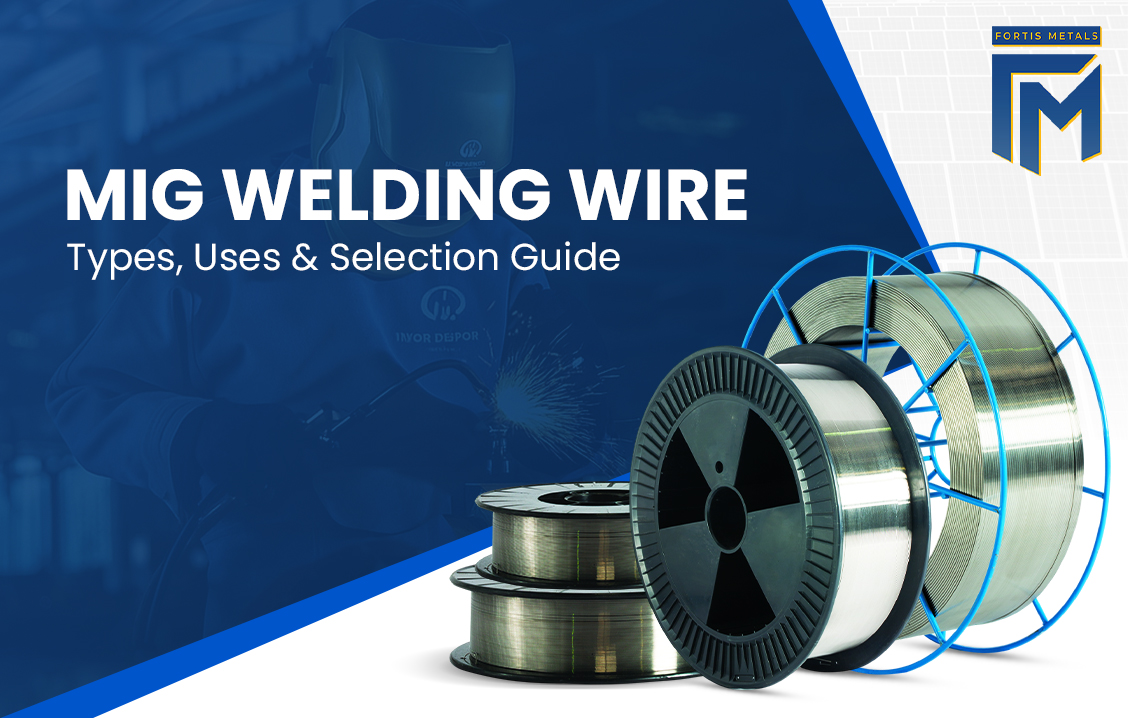
MIG Welding Wire: Types, Uses & Selection Guide
MIG Welding is currently one of the most common types of welding and is used in different industries (automotive, construction, shipbuilding, and manufacturing) for quickly joining metal parts. The MIG Welding wire serves the dual purpose of being both the electrode and the filler. It melts from the heat created when the electrical arc is generated and the two metal parts are joined together. Because of this, MIG welding can produce strong, clean, smooth welds at faster rates, which is why it is often a popular and widely used type of welding, one that the welding industry and the manufacturing industry have come to rely on.
The specific type of MIG Welding wire you select will directly affect the quality of the weld, as will the comfort level of the welder during the weld process. By choosing the correct type of MIG Welding wire for your application, you can help assure that you have the best possible outcome for each weld process. High-quality MIG Welding wires are designed to produce a smooth weld surface, help lessen the amount of spatter from the weld, and ultimately result in less time spent on the clean-up phase after the welding process. Therefore, selecting the appropriate MIG Welding wire is important when welding a high volume of pieces together in a manufacturing production setting, as well as heavy-duty industrial work.
What Is MIG Welding Wire?
The MIG (Metal Inert Gas) Welding Wire is an expendable electrode utilized within the MIG welding process to create a consistent, steady arc. This wire is continuously supplied through the welding gun, and when melted, creates a "filler" to the joint created from the melting of the base metals being joined together. During this time, the atmosphere surrounding the weld area is protected by a "shielding gas", usually Argon, Carbon Dioxide or a blend of both gases. These gases protect the weld area from oxygen, moisture and other contaminants in the air during the welding process.
Solid and Flux-Cored are the two main forms of MIG Wires available. Solid Wires work well in controlled, dry environments, while Flux-Cored Wires include a "flux" contained inside the wire that will allow you to weld in either wind or rain without using a shielding gas.
Properly selecting your MIG Wire has a direct relationship with the appearance, strength, and amount of spatter in the finished weld. Therefore, the proper selection of your MIG Wire is crucial to achieving consistent results efficiently.
Types of MIG Welding Wire
There are a variety of MIG wire products that differ by their material and formulation to be compatible with particular metals and uses:
- MIG Wires for Mild Steel (ER70S-6): This is the most common wire product, which can be utilized as a "general purpose" welder. This product provides very good arc stability and has deep penetration, making it capable of successfully welding mild steel that is mildly rusted or oily.
- Stainless Steel MIG Wires (ER308L, ER316L): These wires provide excellent corrosion protection, thus they are suited for welding applications such as food service, marine and chemical processes where the need for long-term durability and cleanliness is a necessity.
- Aluminium MIG Wires (ER4043, ER5356): Aluminium wires offer excellent conductivity at a light weight, so they are frequently used for automotive, aerospace and fabrication projects that require a great deal of precision and less weight.
- Flux Cored MIG Wires: These wires contain an internal flux that generates the shielding gas as you weld. These are best suited for welding outdoors, in windy conditions, or for structural welding when carrying a gas cylinder is impractical.
Selecting the correct wire diameter and alloy to match your desired thickness of metal, amperage range and position while welding will ensure that you achieve maximum results from your process.
Key Properties and Benefits
High-quality MIG (GMAW) welding wire provides several essential characteristics that contribute to improved performance and durability of the weld:
- Stable arc and consistent feed of wire: This ensures that the welding operation is carried out steadily and without interruptions, thus eliminating irregularities from the weld bead.
- Clean welds with low spatter: Results in welds that have little or no need for post-weld cleaning.
- High tensile strength: Provides strong, resistant welds that can be used where there will be high loads on the joint.
- Resistance to corrosion: This is especially important when using stainless steel and aluminium wires to ensure long-term performance.
- Easy compatibility with a variety of base metals and thicknesses: The quality of MIG wires allows for use with most any metal type and thickness, which makes it easy to set up an efficient system.
- Ease of use: Quality MIG wires are designed for ease of feeding through automated systems, which results in reduced downtime and increased overall efficiency.
Using premium-grade MIG wires not only results in higher levels of production and efficiency, but also reduces the amount of rework and scrap produced, ultimately producing a uniform, high-quality weld which meets the standards of most industries.
Industrial Applications of MIG Welding Wire
Across a wide range of industries, the MIG wire is used to create an endless number of connections because of its flexibility to connect different types of material quickly and cleanly.
- Vehicle Body Panels and Chassis Frames: The most commonly used automotive product for MIG welding is vehicle body panels, chassis frames and exhaust systems, including aluminium parts for better durability and structure.
- Structural Steel Fabrication: In the construction industry, structural steel fabrication uses MIG welding to connect pipes and heavy machinery for long-lasting, reliable connections.
- Aluminium Welding for Ship Building: In the ship building industry, MIG welding aluminium and stainless steel is widely used, especially when connecting parts that will be in contact with water or other wet environments (marine).
- Equipment Fabrication: Manufacturing companies use MIG welding for the mass production of equipment, furniture, rail parts, and industrial assembly.
- On-Site Repairs: For repair and maintenance of equipment, MIG welding provides a flexible and time-efficient way to make on-site welds, using a variety of materials.
For all of these uses, the MIG welding process offers a consistent, clean and fast connection method for both manual and automated processes in large-scale industrial manufacturing.
How to Choose the Right MIG Welding Wire
Choosing the best MIG wire is dependent on a variety of factors that are both technical and environmental:
- Choose the Correct Type of Material for Your Work Piece: Select wire materials that match your base metals (Example: Mild Steel wire for Carbon Steel).
- Select the Right Gauge of Wire: A thicker gauge wire will allow you to run higher current levels and is perfect for Heavy Duty Welding, whereas a thinner gauge wire will be suitable for Sheet Metal Welding.
- Choose Wire Based on Environmental Factors: Solid wires with Argon-based shield gases are used indoors, whereas Flux-Cored wires are used outdoors due to environmental factors.
- Equipment Fabrication: Manufacturing companies use MIG welding for the mass production of equipment, furniture, rail parts, and industrial assembly.
- Verify That Your Wire Has Been Tested and Meets the Standards of AWS, ASTM, or ISO: To ensure your wire is of high quality and consistent.
For all of these uses, the MIG welding process offers a consistent, clean and fast connection method for both manual and automated processes in large-scale industrial manufacturing.
Importance of Choosing a Reliable Supplier
Reliable suppliers of MIG welding wire will provide you with the same quality in each batch, as well as ensure that you can trace the source of your product. Due to precision manufacturing and strict quality control, each batch of MIG welding wire will have the correct chemical makeup, be uniformly formed and be easy to feed into your welding gun.
Most reputable suppliers of MIG welding wire will provide you with certified test results for the tensile strength of the wire, the surface finish of the wire and the compatibility of the wire with gases used during the welding process. This will reduce the potential for weld defect issues when using this type of wire. Suppliers are able to create custom wire sizes and package options as well as produce different types of materials to meet the needs of various industries.
Choosing a trusted supplier of MIG welding wire will allow fabricators to have access to technical assistance with their welding projects, consistent delivery of high-quality wire and help them ensure that every weld they make is both safe and durable.
Why Choose Fortis Metal NA Inc. for MIG Welding Wire?
Fortis Metal NA Inc. is a steel supply company, metal wire manufacturer and distributor specializing in high-quality MIG Welding Wires for various industries across the world, providing customers with premium quality products while adhering to its own strict manufacturing guidelines for performance and precision.
The Fortis Metal NA Inc. product line includes, but is not limited to, a full line of mild steel, stainless steel, aluminium and flux-cored MIG wires for use in a variety of different welding conditions and applications.
Our each of the product is tested and certified as compliant with all international welding codes and standards, and we utilize the most modern manufacturing techniques to produce the strongest and most reliable products possible and to meet our customers' expectations for quality and performance.
To witness consistent, clean and strong welds every time, choose us as your number one source for premium MIG Welding Wires.
Conclusion
High-quality MIG Welding Wire is critical in delivering an economical, strong and clean weld. It provides a cleaner joint, improved weld strength and reduces rework, which are important for maximizing production while ensuring structural integrity of the weld.
Working with a reliable welding wire supplier is important when you need to ensure quality welds. As one of the leading suppliers in the industry with over 30 years of experience in supplying welding wire products worldwide, we at Fortis Metal NA Inc. have established ourselves as an industry leader in providing quality welding wire products. When you need MIG Welding Wire to perform at a high level, choose Fortis Metals, your best choice for top-quality MIG Welding Wires.